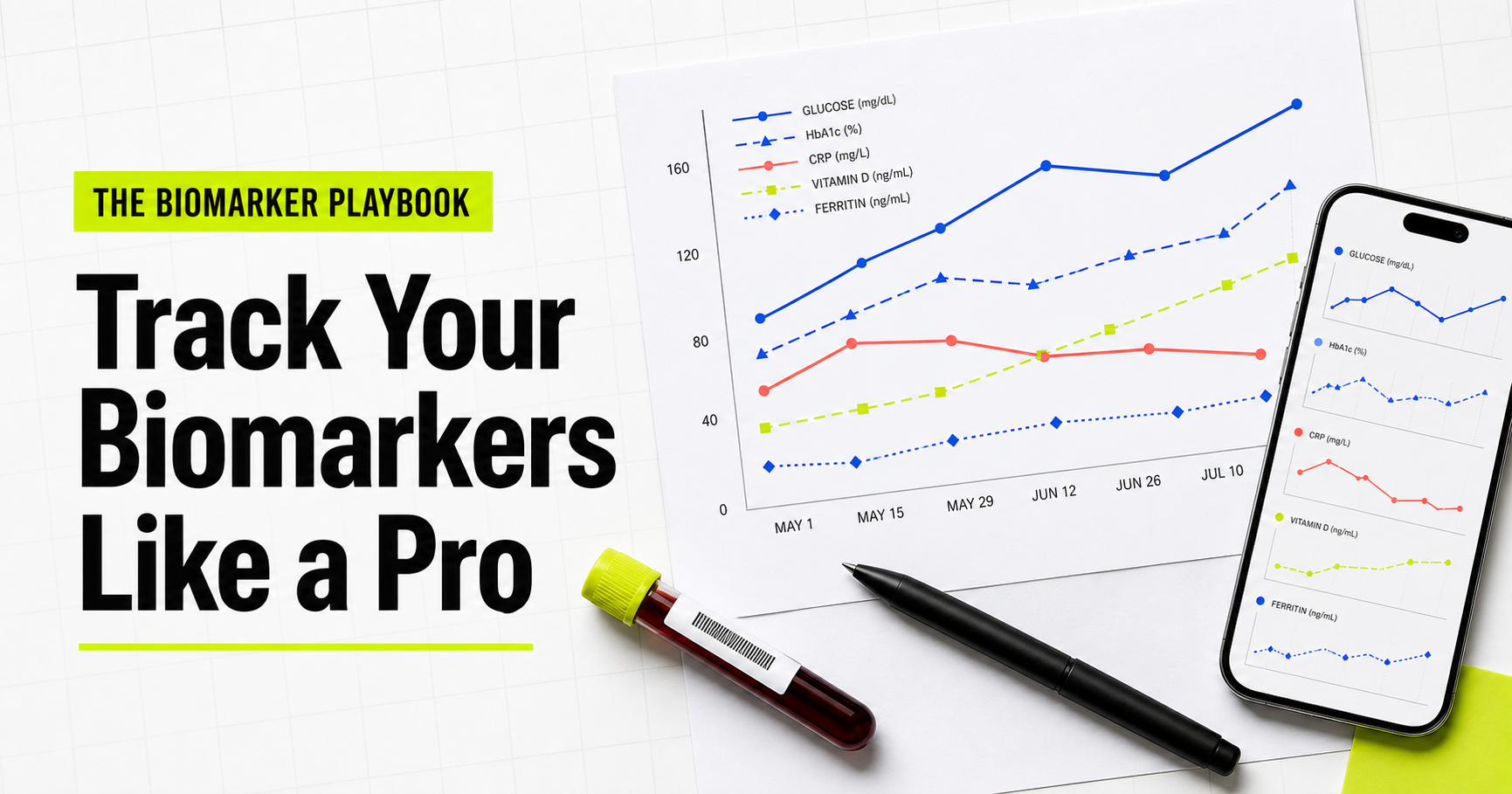
Best Way to Track Your Biomarkers Like a Pro: A Biohacking Guide
The professional move is not ordering the biggest panel. It is building a repeatable system that turns comparable results into better questions, safer experiments, and useful clinical context.
The best way to track biomarkers is to define the decision first, establish a well-documented baseline, keep collection conditions as consistent as practical, change one major variable at a time, and compare trends with the original units and reference ranges. Use the record to prepare questions for a clinician, not to diagnose yourself from one number.
ARTICLE SHORTCUTS
Go straight to the part you need.
This guide is built for scanning. Each shortcut jumps to a complete answer.
A biomarker is a measurable characteristic that gives information about a normal biological process, a disease process, or a response to an exposure or intervention. That can include a molecule in blood, a measurement such as blood pressure, or a clinically validated signal collected another way.
The National Cancer Institute definition of a biomarker is deliberately broad. It also explains why the word is easy to misuse. A number can be measurable without being meaningful for your question, and a statistically interesting association is not automatically a useful personal target.
Biohacking adds another layer: repeated measurement before and after a deliberate change. That can be valuable when the marker is appropriate, the data are comparable, and the intervention is safe. It becomes much less useful when the panel keeps expanding, collection conditions change, or every out-of-range flag triggers a new supplement.
A laboratory flag is not a diagnosis. Reference ranges, clinical thresholds, treatment targets, symptoms, medications, age, and overall risk answer different questions.
02 / THE PROTOCOL
The seven-step biomarker tracking loop
Treat this as a lightweight operating system. You can use it for a single lab value, a clinician-directed panel, or a broader personal health record.
01
Define the decision
Start with a real question: establish a baseline, monitor a diagnosed condition, check a clinician-guided intervention, or understand a persistent symptom. A test without a decision attached often creates data without direction.
02
Choose a focused panel
Select the smallest set that can answer the question. Include clinician-recommended screening and monitoring first. Add exploratory markers only when you understand the evidence, limitations, and likely follow-up.
03
Capture a clean baseline
Record the date, lab, units, reference range, fasting status, time of day, medications, supplements, recent illness, sleep, hydration, and hard exercise. Those details help explain apparent change.
04
Change one major variable
When practical, avoid launching five supplements and a new diet on the same day. A simpler intervention makes the next result easier to interpret, although real life will never be a perfect experiment.
05
Retest on the right cadence
The interval depends on the marker, the clinical reason, the intervention, and your care plan. Use a clinician-guided schedule instead of retesting everything weekly or waiting arbitrarily.
06
Read the trend in context
Compare like with like, look for a sustained pattern, and consider symptoms, measurements, treatment changes, and reference ranges. One outlier is a signal to investigate, not a diagnosis by itself.
07
Turn data into a question
Bring a one-page timeline to a qualified clinician: what changed, when it changed, what else was happening, and what decision you need to make. The best dashboard ends in a better conversation.
03 / WHAT TO TRACK
Which biomarkers are worth tracking?
Start with markers tied to your history, preventive care, symptoms, medications, and goals. The categories below are a map for discussion, not a universal shopping list.
METABOLIC + CARDIOVASCULAR
Track risk patterns, not isolated “good” numbers.
Blood pressure, glucose regulation, and lipids are common starting points because they connect to established health decisions. HbA1c reflects average blood glucose over roughly the previous two to three months; a fasting glucose is a shorter snapshot. Lipid interpretation may include LDL cholesterol, HDL cholesterol, triglycerides, and broader risk context.
The American Heart Association’s Know Your Health Numbers guidance emphasizes that goals should be individualized with a healthcare team. For a practical taxonomy of glucose, insulin, lipids, and related measures, explore this metabolic biomarker guide.
Keep the measurement method and units visible.
Pair lab values with blood pressure and relevant clinical context.
Ask which change would alter care, not only which value looks “optimal.”
THYROID
Interpret the panel as a system.
Thyroid results depend on the reason for testing, symptoms, pregnancy status, medications, supplements, and pituitary-thyroid physiology. TSH is commonly the initial test, while free T4 can help interpret what the thyroid is producing. More testing is not always more informative.
Keep TSH and free T4 dates aligned when comparing a panel.
Ask why an additional thyroid test would change the next decision.
Blood count and chemistry
A clinician may use a complete blood count or metabolic panel for screening, symptoms, medication monitoring, or an overall health picture. Track the component, unit, range, and clinical reason; do not compress a multi-part panel into one score.
Iron, nutrients, and inflammation
Ferritin, iron studies, vitamin levels, and inflammatory markers can be useful when history or symptoms support the question. They also have confounders. Repeated broad testing without a decision plan can turn normal variation into unnecessary alarm.
Wearables and daily signals
Sleep, resting heart rate, training load, and other consumer-device metrics can add day-to-day context between lab draws. Treat device estimates as a separate data stream with their own error, not as substitutes for clinical measurements.
04 / DATA QUALITY
Your trend is only as clean as your collection notes.
Biomarker tracking rewards consistency. It does not require laboratory-perfect living; it requires enough context to see when two results are not truly comparable.
LAB
Keep the original report
Store the result, unit, method when available, and that laboratory’s reference range. MedlinePlus explains that labs may use different methods and ranges, so following a trend with the same lab can make comparisons easier. Read the full guide to understanding lab results.
BODY
Document preparation and confounders
Note fasting, time of day, hydration, intense exercise, acute illness, menstrual timing when relevant, sleep disruption, prescriptions, over-the-counter products, and supplements. Follow the preparation instructions given for the specific test.
TIME
Choose a biologically sensible interval
A marker that reflects months of physiology should not be judged like a momentary reading. A medication safety check may follow a specific clinical schedule. Define what change you expect, how quickly it could plausibly appear, and who will review it.
HOME
Verify consumer testing claims
At-home access can be convenient, but evidence and oversight vary. The FDA overview of direct-to-consumer tests explains analytical validity, clinical validity, limitations, and why results should not be the sole basis for medical decisions.
05 / THE DASHBOARD
Build one view that preserves the evidence.
A good dashboard is a map back to the source report. It helps you notice patterns without hiding units, ranges, dates, or the uncertainty behind the chart.
ILLUSTRATIVE PROFILE90-day review
3 lab dates / 6 context notes
HigherBaselineLower
MayJunJulAugSep
Marker A Marker B Marker CNormalized illustration only. Always retain actual units and ranges.
Spreadsheet
Best when you want full control and can enter data carefully. Use one row per result and separate columns for value, unit, range, lab, fasting status, and notes. Link each row to the original report.
Biomarker tracking app
Best when imports, charting, search, document storage, and sharing would reduce friction. A dedicated biomarker tracking app can keep reports and longitudinal trends together, but you should still verify exports, privacy, and manual corrections.
Clinician portal
Best for official results from one health system and direct care-team communication. Portals may not consolidate outside labs or preserve your independent lifetime record, so keep portable copies of important reports.
06 / FAILURE MODES
Six mistakes that make biohacking data less useful
01
Testing without a decision
If no plausible result changes what you do next, the test may add cost and anxiety without adding useful information.
02
Chasing the “optimal” range
Ask where the range came from, whether it is a laboratory reference interval or a clinical target, and whether it applies to your situation.
03
Changing too many variables
A supplement stack, new diet, extra training, and reduced sleep can move together. Record all of them and resist claiming a single cause.
04
Comparing unlike results
Different units, methods, laboratories, collection times, and preparation can create apparent trends. Preserve the source details.
05
Reacting to one outlier
Unexpected results deserve attention, but the appropriate response may be confirmation, clinical review, or urgent care depending on the value and symptoms.
06
Optimizing the dashboard instead of your health
A perfect chart cannot replace sleep, movement, nutrition, treatment adherence, preventive care, or a qualified professional who knows your history.
07 / MAKE IT ACTIONABLE
Bring a one-page brief to your next appointment.
1 The decision or symptom you are trying to understand
2 Three to five relevant trends with dates, units, and ranges
3 Medication, supplement, illness, sleep, diet, and training changes
4 The original reports and your three most important questions
COMMON QUESTIONS
Biomarker tracking FAQ
Direct answers to the questions people ask before building a lab-results dashboard.
01What biomarkers should I track for biohacking?
Start with markers that match your health history, symptoms, preventive-care needs, and a decision you can actually make. Common areas include blood pressure, glucose regulation, lipids, and clinician-selected blood chemistry. Thyroid, nutrient, hormone, inflammation, or performance markers may be useful in the right context, but a large universal biohacking panel is not automatically better.
02How often should I test my biomarkers?
There is no single schedule for every biomarker. The right interval depends on what the marker represents, why it was ordered, how quickly it can change, the intervention being evaluated, and your clinician's plan. Retest when enough time has passed to answer the original question, not simply because a dashboard is available.
03What is the best way to track blood test results over time?
Keep the original report, record the value, unit, reference range, date, lab, and collection conditions, then graph only comparable results. Add concise notes for medication, supplement, illness, fasting, sleep, and training changes. A spreadsheet can work; a purpose-built app may reduce manual entry and make reports easier to review.
04Can wearable data be tracked with lab biomarkers?
Yes, as context. Resting heart rate, sleep duration, training load, and other device measurements can help explain what was happening between blood draws. Wearable estimates and clinical laboratory measurements are not interchangeable, and a consumer-device trend should not be treated as a diagnosis.
05Are at-home biomarker tests accurate?
Accuracy and clinical usefulness vary by test, collection method, laboratory, and intended use. Follow the instructions precisely, check whether the test has appropriate regulatory review, understand what it can and cannot establish, and discuss meaningful or unexpected results with a qualified healthcare professional.
06How do I know whether a supplement changed a biomarker?
Document a stable baseline, the exact product and dose, the start date, adherence, other changes, collection conditions, and a sensible retest interval. Even then, an association is not proof of cause. Review safety, interactions, symptoms, and the full clinical context with a professional before continuing or changing treatment.
07Is an optimal range different from a laboratory reference range?
It can be, but the terms are often used too casually. A laboratory reference range describes values seen in a reference population and depends on the method and lab. A treatment target or risk threshold may come from clinical guidance and can vary by age, condition, medication, and overall risk. Ask what evidence supports any claimed optimal range.
ASK WITH BETTER CONTEXT
Use an AI assistant to organize the questions, not make the diagnosis.
Each button opens the same safety-aware planning prompt. Add your goals, history, and results carefully, and avoid sharing information you do not want the service to retain.
Help me build a safe, evidence-aware plan to track biomarkers over time. Compare metabolic, cardiovascular, thyroid, blood count, and wearable metrics; explain which are clinically useful for my goals, what can distort results, how often they may need retesting, and what questions I should ask a qualified clinician. Do not diagnose me or recommend a universal panel.
Medical scope: This educational guide does not diagnose, prescribe, recommend a universal test panel, or replace personalized medical care. Do not delay urgent evaluation because of a dashboard or AI response. Discuss testing, unexpected results, medications, and supplements with a qualified healthcare professional.